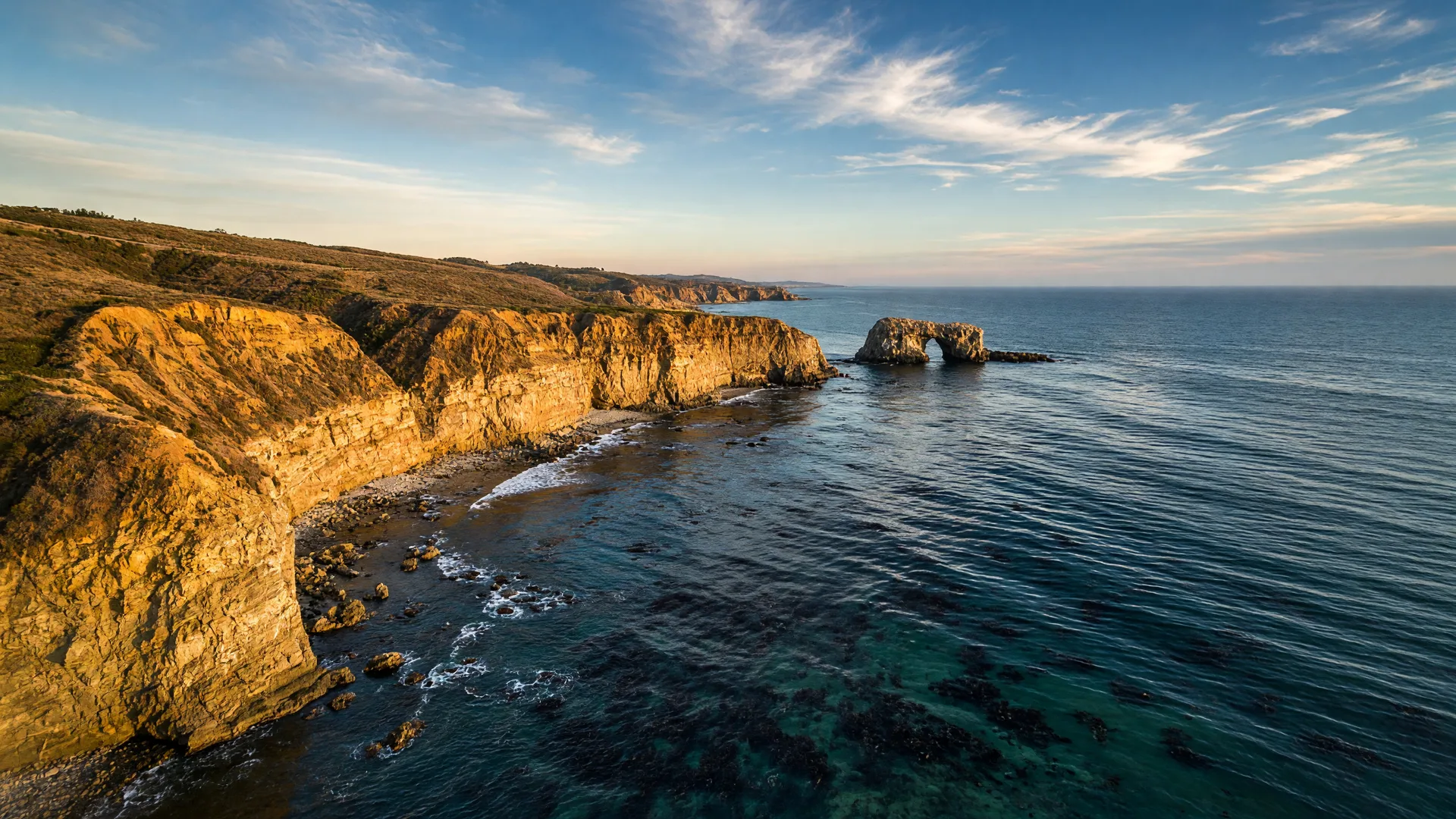
New series installment
California's Own Galápagos: The Channel Islands Story
By JC Pacific Corp Published November 4, 2026 California, Did You Know?, Edition 2
Eleven to seventy miles off the Southern California coast, in plain sight of one of the most populated regions on the planet, sits a national park with no roads, no hotels, and only five islands: Channel Islands National Park. Often called North America's Galápagos, it is home to the island fox, the smallest wild canid on the continent, along with 145 species found nowhere else on Earth. Its islands hold fossils of pygmy mammoths and human remains among the oldest in North America, and one of its sea caves is among the largest in the world. This is the story of the Channel Islands, and what to know before you go.
Quick facts
11-70 miles
How far the five park islands lie offshore; there are no bridges, so every visit begins with a boat
1980
Year Channel Islands National Park was established, protecting five of the eight islands
145
Plant and animal species found nowhere else on Earth, including the island fox
1,227 ft
Length of Painted Cave on Santa Cruz Island, among the largest sea caves in the world
April-June
The classic spring window for green hills, wildflowers, and nesting seabirds
Where exactly are the Channel Islands, and which are in the park?
The Channel Islands are an eight-island archipelago off the Southern California coast, roughly opposite the coastline between Los Angeles and Santa Barbara. Five of the eight form Channel Islands National Park, established March 5, 1980: Anacapa, Santa Cruz, Santa Rosa, San Miguel, and Santa Barbara. The park covers about 249,561 acres, roughly half of it underwater, and protects the islands, their shorelines, and the ocean around them. The other three islands, including well-known Santa Catalina with its harborside town of Avalon, are managed separately and are not part of the park.
There are no bridges, no roads connecting the islands, and no cars. Every trip begins with a boat, usually the park concessionaire Island Packers Cruises from Ventura Harbor or Channel Islands Harbor in Oxnard. Anacapa, the closest island, sits about 11 to 14 miles offshore and is roughly an hour from the mainland; Santa Cruz is about 20 miles out and 60 to 90 minutes away; San Miguel, the farthest, lies about 60 miles out and takes several hours to reach.
In the park
Anacapa, Santa Cruz, Santa Rosa, San Miguel, Santa Barbara
Wild islands run by the National Park Service, reached by ferry or plane, camping only
Outside the park
Santa Catalina, San Clemente, San Nicolas
Managed separately; Catalina has the town of Avalon and regular ferry service
The short answer: the Channel Islands are an eight-island chain 11 to 70 miles offshore, and five of the eight belong to a national park that is reachable only by boat.
Why is this place called North America's Galápagos?
The nickname is earned. Islands separate species from their mainland relatives, and given time, they evolve into new forms. More than 2,000 plant and animal species have been recorded on the Channel Islands, and 145 of them occur nowhere else on Earth. The island scrub-jay lives only on Santa Cruz Island, a single island about 20 miles offshore. The island night lizard is found wild only on a few of the islands. The same process of isolation that made the Galápagos famous is happening here, at California scale.
Much of the wildlife is marine, and the islands sit in some of the most productive waters along the West Coast. Giant kelp forests grow in the cold, nutrient-rich currents, sheltering fish, sea lions, and migrating whales. The kelp itself is part of the draw: a dense canopy of giant kelp supports a web of life from the seafloor to the surface.
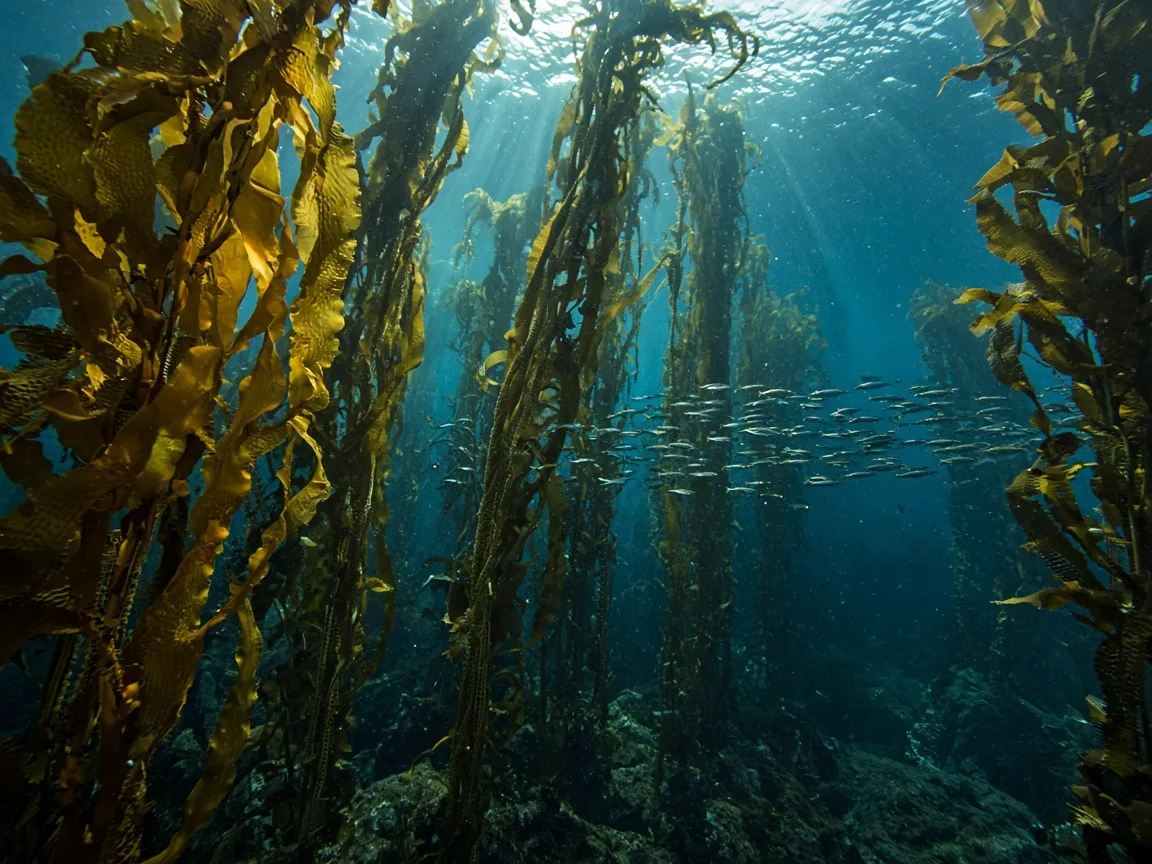
Kelp forests around the Channel Islands support an unusually rich marine food web and draw divers, kayakers, and whale watchers to the park.
The island fox almost vanished. How did it come back?
The island fox is North America's smallest wild canid, about the size of a house cat, and it lives nowhere but the Channel Islands. Over time, foxes on separate islands evolved into six distinct subspecies, each unique to its own island, a level of isolation rarely seen on the mainland. It is also one of the best conservation comeback stories in the country.
In the late 1990s, four island populations crashed by more than 90 percent. Golden eagles, which had moved in after bald eagles disappeared from the islands in the wake of DDT contamination, began preying on the foxes. San Miguel and Santa Rosa each dropped to roughly 15 foxes, and Santa Cruz fell below 80 by 2000; a canine distemper outbreak devastated the Santa Catalina population at the same time. In March 2004, four of the subspecies were listed as endangered under the Endangered Species Act.
The recovery combined captive breeding, relocating golden eagles, removing feral pigs that had become an eagle food source, restoring bald eagles to the sky, and vaccinating the foxes against distemper. By August 11, 2016, the U.S. Fish and Wildlife Service declared the San Miguel, Santa Rosa, and Santa Cruz foxes recovered: the fastest recovery of any mammal ever listed under the Endangered Species Act. Park-wide estimates climbed above 4,000 mature foxes, up from fewer than 1,500 in 2002, and more than 3,000 foxes now live on Santa Cruz Island alone. The Santa Catalina fox remains listed as threatened and is still recovering.
The short version: in about fifteen years, the island fox went from the edge of extinction to the fastest recovery of any listed mammal, thanks to a partnership of federal agencies, scientists, and the public.
Where do pygmy mammoths and 13,000-year-old humans fit in?
The islands have been writing their own history for a very long time. During the last ice age, lower sea levels joined the four northern islands into a single landmass, and mainland mammoths that reached it evolved, in isolation, into a dwarf form: the pygmy mammoth (Mammuthus exilis). Adults stood only about 5.6 to 6.6 feet at the shoulder, roughly a sixth the size of their Columbian mammoth ancestors, and they walked these islands for hundreds of thousands of years before going extinct more than 10,000 years ago. Today, Santa Rosa Island holds the most complete pygmy mammoth skeletons ever found, including one excavated by park and U.S. Geological Survey scientists as recently as 2016.
People arrived remarkably early too. In 1959, a Santa Barbara Museum of Natural History curator found two human thigh bones eroding from Arlington Canyon on Santa Rosa Island. Radiocarbon dating later put the bones at roughly 13,000 years old, making them among the oldest human remains ever found in North America. Because the islands were even then separated from the mainland by open water, someone had crossed that water by boat, thirteen millennia ago.
Those early mariners were ancestors of the Chumash, whose descendants still call the islands home territory today. The Chumash crossed the channel in tomols, ocean-going plank canoes built without ribs from redwood planks and sealed with pine pitch and asphaltum, and lived on the northern islands for more than 13,000 years before European contact. The park now partners with Chumash communities, and since 2001 an annual tomol crossing has returned paddlers to Limuw (Santa Cruz Island) at Scorpion Cove, an event that keeps the islands' living culture connected to the place where those bones were found.
Can you visit the Channel Islands? What to know before you go
Yes, and a day trip is very doable, especially to Santa Cruz or Anacapa, the two islands closest to the mainland. The park charges no entrance fee; your main expenses are the ferry, camping, and any tours. The catch is that everything must be planned ahead: boat space is limited, reservations open months in advance, and in winter, weather can cancel outer-island trips.
Getting there
- Island Packers Cruises is the park's boat concessionaire, running year-round service from Ventura Harbor and Channel Islands Harbor in Oxnard. Reservations are required and weekends fill well ahead, so book early on islandpackers.com .
- Which island: Santa Cruz has the most frequent service, about five to seven days a week year-round, with Anacapa running fewer days. Santa Rosa and San Miguel trips generally run April through early November, and Santa Barbara Island currently requires a private boat because ferry landings are suspended. For a first visit, Santa Cruz is the standard choice.
- Fares: round-trip day tickets to Santa Cruz are listed at $72 per adult (ages 13 to 54), $67 for seniors and military, and $52 for children 3 to 12, with higher camper fares for overnight trips. Rates vary by island and season and can change, so check the current schedule before booking.
Staying overnight
- Camping is the only lodging. There are no hotels or stores on the islands. All five islands have National Park Service campgrounds, open year-round, with permits reserved through Recreation.gov on a rolling six-month window; there are no walk-ups.
- Pack it in, pack it out. Most campgrounds have no running water, so visitors bring every gallon they need and carry all trash back to the mainland. Anacapa's campground is a half-mile inland up 157 stairs, which is why many first-time campers choose Santa Cruz.
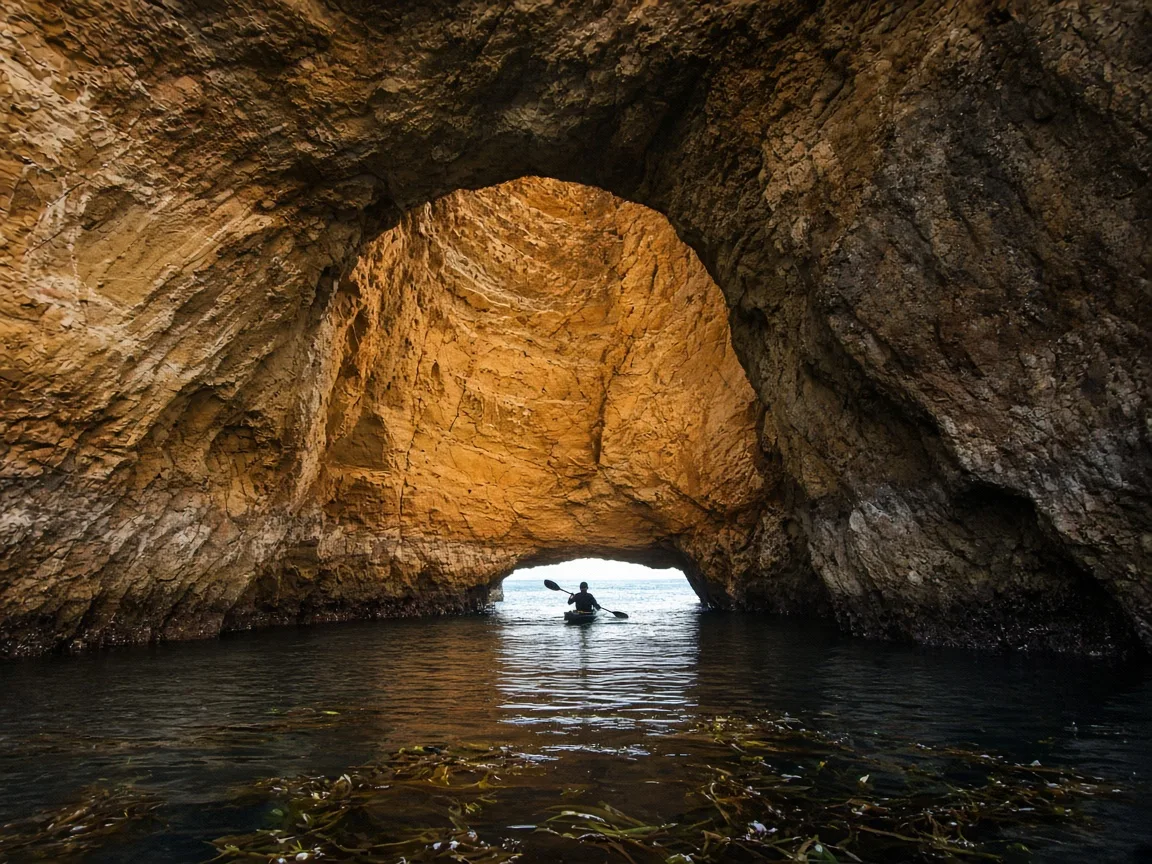
Sea cave kayaking is the signature Channel Islands activity. Painted Cave on Santa Cruz Island runs about 1,227 feet into the cliff, making it one of the largest sea caves in the world.
On the water and practical notes
- Kayaking: paddling into the sea caves is the signature activity, and many visitors go with authorized commercial outfitters who guide kayak trips from the island landings. The National Park Service requires proper safety gear and navigation skills for independent paddlers; fog is common, and a chart and compass are mandatory.
- The fox rule: island foxes are bold around people and will raid a camp for food. Park rules prohibit feeding wildlife and require food to be stored securely, and pets are not allowed because they can carry diseases fatal to foxes.
- Season: April through June brings green hills, wildflowers, and nesting seabirds; August through October has the calmest seas for kayaking. Gray whales migrate past the islands from about December through April, so winter trips can double as whale watching. Check the current park visitor page before you book.
Why are the islands worth a visit now?
On a clear day you can see the Channel Islands from the Southern California coast, yet most people who live here have never set foot on one. That is part of the appeal: the islands are closer than most weekend destinations, and they feel like the coast did before the freeways. A national park with no cars, no gift shops, and no pavement, where the checkout line is replaced by a boat schedule, is a genuinely rare thing, and it is 11 to 70 miles from one of the most populated regions in the country.
For a closer look at planning and natural history, the official Channel Islands National Park website is the most reliable source for schedules, conditions, and alerts, and the park's island fox page tells the recovery story in more detail. If you would rather see it in person, a Santa Cruz day trip from Ventura makes a memorable introduction, and the same harbor that launches the ferries is a fine place to watch the boats come home at sunset.
A starting point, not a lecture
This story is a starting point for your own visit or your own reading. Ferry schedules, fares, camping availability, weather, and island access all change, so confirm current conditions with the National Park Service and Island Packers before you travel.
Channel Islands questions, answered
How far are the Channel Islands from the California mainland?
The five park islands lie about 11 to 70 miles offshore. Anacapa is closest, roughly 11 to 14 miles out and about an hour by ferry; Santa Cruz is about 20 miles and 60 to 90 minutes; Santa Rosa is about 26 miles; Santa Barbara Island about 38; and San Miguel, the farthest, about 60 miles and several hours. Distances are measured across open water, since there are no bridges.
How do you get to the Channel Islands?
By boat, almost always the park concessionaire Island Packers Cruises, which runs year-round service from Ventura Harbor and Channel Islands Harbor in Oxnard. There are no bridges, no roads to the islands, and no automobiles in the park. Reservations are required and generally open months in advance because space is limited.
How much does a trip to the Channel Islands cost?
Channel Islands National Park itself charges no entrance fee; the real cost is transportation. Island Packers lists round-trip day fares to Santa Cruz at $72 per adult (ages 13-54), $67 for seniors and military, and $52 for children 3-12, with infants free, and higher camper/overnight fares. Rates and schedules vary by island and season, so check the current fare list before booking.
Can you stay overnight on the Channel Islands?
Yes, but only by camping. The park maintains NPS campgrounds on all five islands and camping is open year-round with a permit reserved in advance through Recreation.gov, on a rolling six-month window with no walk-ups. There are no hotels, stores, or restaurants; most campgrounds have no running water, so visitors pack in everything, including water, and pack out trash.
When is the best time to visit the Channel Islands?
Spring, roughly April through June, is the classic window for green hills, wildflowers, and nesting seabirds. For the calmest seas for boating and kayaking, late summer into fall, about August through October, is best. Summer has the clearest underwater visibility but also more crowds, wind, and fog, and winter trips to the outer islands are often canceled for weather. Gray whale watching runs from about December through April.
What animals are found only on the Channel Islands?
More than 145 species of plants and animals are endemic to the islands, meaning they occur nowhere else on Earth. The best known are the island fox, North America’s smallest wild canid; the island scrub-jay, which lives only on Santa Cruz Island; the island night lizard; the island deer mouse; and the island spotted skunk.
California has a way of making it easy to imagine staying awhile, and places like the Channel Islands are part of the reason: even a state with this much coastline keeps a wild corner you did not expect. If you are thinking about making California home, the JC Pacific team would be happy to help you explore what that could look like, from oceanfront communities to inland valleys. Come back next month, when the next edition of California, Did You Know? brings another story worth knowing.
Return to the series
Come back for the next edition of California, Did You Know?
One installment lands each month, each one built around a surprising but true story about California and Southern California living. If a place, a fact, or a hidden gem has always made you wonder, tell us: your idea could become a future edition.
Facts, figures, and visitor details in this installment were checked against public sources at publication time. Stories in this series are written for education and enjoyment; they are not legal, tax, lending, or investment advice.